Lötschentaler Bohne
Sorry, this entry is only available in Deutsch. Lötschentaler Bohne

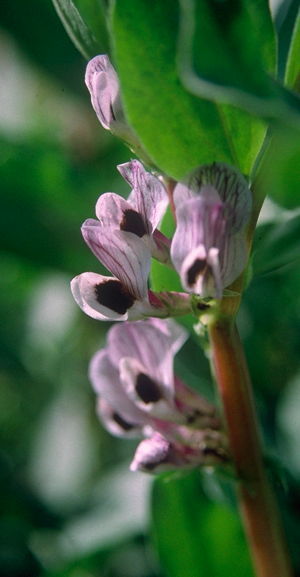 The broad bean (Vicia faba) together with lentils and peas is one of the most important legumes of early agriculture. The oldest findings in the Near East were dated to 6,500 B.C. The strong, vertically growing plant forms legumes with relatively large seeds.
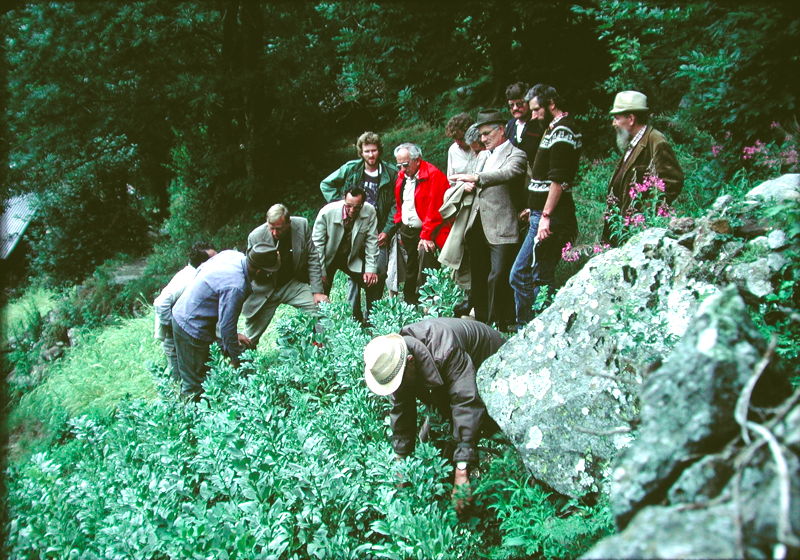
The broad bean was widespread in high valleys. It needs relatively large amounts of water. The towns at the end of a valley usually receive more precipitation as the towns in the middle of the valley or at its send. From the Middle Ages into the 19th century the broad bean was the most important legume and principal food source. It contains about 25-30% protein and important minerals. In the 18th century the broad bean was progressively displaced by the potato and the green bean (Phaseolus vulgaris) from the New World.
Broad beans are subdivided by bean size in: Small seeded beans (Vicia faba var. minor), middle seeded beans (Vicia faba var. equina) and large seeded beans (Vicia faba var. major).
Literatur:
Schilperoord, Peer und Heistinger, Andrea (2011): Literaturstudie alpine Kulturpflanzen Vs. 5.1.
Zohary, Daniel; Hopf, Maria; Weiss, Ehud (2012): Domestication of plants in the Old World. The origin and spread of domesticated plants in Southwest Asia, Europe, and the Mediterranean Basin. 4. Aufl. Oxford: Oxford University Press. ISBN: 978-0199549061
Sorry, this entry is only available in Deutsch. Lötschentaler Bohne
Lesachtaler Hosbohne